Wilmington Pulls Plug on Analog TV
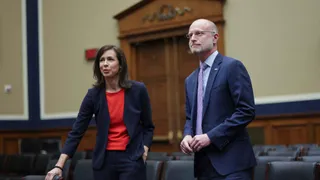
FCC chairman Kevin Martin and Wilmington, N.C., Mayor Bill Saffo flipped huge, symbolic digital switch to end full-power analog TV in market.
By John Eggerton -- Broadcasting & Cable, 9/8/2008 1:26:00 PM
| Blogging the Wilmington Project: Carol Ingley, author of Digital or Dark, is on the scene in Wilmington, N.C. where she'll live-blog on the Sept. 8 analog shut-off. Click here to read. DTV Transition 101: To watch a video guide to the February 2009 analog shutoff, including a step-by-step demo on hooking a converter box, click here. |
At noon Monday, Federal Communications Commission chairman Kevin Martin and Wilmington, N.C., Mayor Bill Saffo flipped a huge, symbolic digital switch to end full-power analog TV in the market, the first to go all-digital.
The move was symbolic, with all of the stations pulling the plug on analog keyed to the symbolic plug-pulling. The switch actually looked like a giant light switch.
At a ceremony in Wilmington, broadcasters, government officials and Saffo all praised the cooperative effort over the past several months since Wilmington was announced as the test market May 8.
On hand were representatives of the stations involved, as well as National Association of Broadcasters president David Rehr, National Telecommunications and Information Administration acting head Meredith Attwell Baker, reporters and others.
Martin, Saffo and Price agreed that one of the key results of the test market was to demonstrate how government and industry could work together. "Competition has played no part in this transition," said Price.
Gary McNair, vice president and general manager of WECT-TV, the NBC affiliate in Wilmington, agreed that cooperation among traditional competitors was key, although he said he was ready to put the competitive gloves back on.
Hank Price, president of the North Carolina Association of Broadcasters, called it the most important thing to have happened in broadcasters' lifetimes regarding TV. He pointed out that the NTSC (National Television Systems Committee) standard for analog transamissions had been around since World War II and, had it been a person, it would be eligible for Social Security or Medicare, suggesting that it was time for analog TV to retire.
Martin and Saffo gave broadcasters high praise for their education efforts -- praise returned by the broadcasters for the FCC's and NTIA's efforts to reach out to the community and, in the NTIA's case, to make sure DTV-to-analog converter boxes were available for over-the-air households.
On the topic of education, Saffo said Wilmington and Thalian Hall in particular were appropriate venues for broadcaster education because former NBC and ABC newsman David Brinkley was reported to have read every book in the hall, which also held a library.
Price also announced that North Carolina broadcasters would continue to try to educate viewers about the wider digital-TV transition. He is calling on all North Carolina broadcasters to hold a "soft" analog-cutoff test Sept. 17.
McNair said he hoped the Wilmington test would not be judged by the number of calls the FCC got to its call center, but instead by looking at all they had learned.
FCC commissioner Michael Copps was also on hand in Wilmington. Martin cited Copps as the driving force behind the test, challenging Martin and broadcasters to find a market that would make the switch early. Actually, Copps had wanted more markets to test the switch, and he made that point again Monday.
He said he wished more communities had shown the "profile in courage" of Wilmington to step up, adding that it could have give the FCC a far fatter playbook on which to draw, with different terrain and topography to test.
Martin has pointed out that there were only a handful of markets that met the FCC's defintion of ready to go early, and only Wilmington volunteered.
Copps also took the opportunity to put in a plug for localism, saying that the new multicast channels made possible by digital TV gave broadcasters an opportunity to better serve their communities through more local news, minority programming and political coverage.
Martin said three of the things the FCC learned were the importance of working with grassroots organizations in the local community, the importance of being prepared for an emergency and the decision by Wilmington stations to lengthen the time of their one-minute analog-shutoff test conducted two weeks ago.
The FCC has already applied the first lesson, announcing that either FCC staffers or commissioners will visit some 80-plus markets with high over-the-air-only viewership to do some hands-on educating.
On the issue of emergency preparedness, Martin pointed to the introduction of a battery pack last week so that DTV-to-analog converter boxes could work on battery-powered TVs in case of emergency. Tropcial Storm Hanna had come through Wilmington late Friday into Saturday but had not done enough damage or knocked out enough power to delay the test.
Baker said key takeaways from the test were the importance of viewers getting their converter boxes early to avoid any last-minute rush on boxes and to troubleshoot any problems.
Rehr praised the cable and satellite industries for the technical coordination it took to make the switch and said cooperation was key going forward. He also pointed to the importance of coordinating the education and outreach efforts, which he called "nothing short of exemplary," and he emphasized that the education had to be "multiplatform."
Not making the trip to Wilmington from the FCC were commissioners Jonathan Adelstein, Robert McDowell and Deborah Taylor Tate.
McDowell was said to be preparing for his own DTV road trip to Tulsa, Okla. He was in Alaska on a similar mission last week (two of the cities he is visiting as part of the 80-market tour).
Adelstein was on a plane headed to Seattle to speak at a conference, then off to San Francisco on his own DTV-related visit, according to his office.
Tate was not there, her office said, due to a scheduling conflict. She is scheduled to make a DTV road-trip stop in Atlanta at the end of the month.
-
Consumer Reports has just upgraded their ratings on some of the available converter boxes
While cable and satellite program providers will continue to serve the great majority of homes as the primary signal source, missing HD local reception, compression issues, higher costs, billing add-ons, service outages, contact difficulties, in-home service waits and no shows have left many of these subscribers looking to OTA antennas as a good, alternative and Off-Air viewers happy with their free programming.
But TV reception starts with the right antenna and Off-Air TV is FREE.
Viewers should certainly try their old antenna first. It’s true that any of these older antennas will pick up some signals, maybe all the broadcast signals a viewer wants to receive, depending on their location. If they’re getting all the OTA channels they want, than they’re good to go.
While Antennas can’t tell the difference between analog and digital signals, there are definitely certain models which have higher DTV batting averages than others. Not all antennas are equally suited for DTV. A percentage of viewers will require something a little more tailored for DTV reception.
With one of the newer and smaller OTA antennas, with greatly improved performance, power and aesthetics, viewers may also be able to receive out-of-town channels, carrying blacked out sports programs not available locally, several additional sub-channels or network broadcasts. And for those with an HDTV, almost completely uncompressed HD broadcasts (unlike cable or satellite).
OTA viewers can go to antennapoint.com to see quickly what stations are available to them, the distance, and compass heading to help in choosing and aiming their antenna. And if they decide to buy a newer antenna, they should buy it from a source that will completely refund their purchase price, no questions asked, if it doesn’t do the job.
Michael Sherman - 9/9/2008 11:39:00 AM EDT -
That couldn't help any from getting a free signal. I tried picking up local hd stations up in the mountains. It was useless and frustrating. I just glad DirecTV provides me distant networks in hi definition. paying the fee for professionalism is better. RV is what I live in during the summer. DTV boxes are not the best. A amplified OMNI Directional antennae will work..
THOMAS INGRAM II - 9/8/2008 9:57:00 PM EDT -
But will DTV work in teeming rain? You mention Hurricane Hanna not delaying the test... but it is my understanding taht DTV won't work in a teeming rainfall, let alone a hurricane. Has the FCC, or B&C, addressed the inclement weather issue? What good are battery-powered converters if the signal can't get thru thick weather? Should analog backup be part of the permanent plan? And doesn't that call into question the whole spectrum-gab issue? Please tell me if anyone has addressed the bad weather issue.
Adam Smith - 9/8/2008 6:00:00 PM EDT
No related content found.
-
No Top Articles